Tuesday, June 29, 2010

The Business of Charitable Giving - Part II

Before choosing how to give, you should choose who to give to.  For ideas about finding a charity aligned with your own target market, please see PART I - Selecting a Charity.
 
BUSINESS CHARITABLE GIVING - PART II - Selecting a Manner of Support

Product
All of the examples in Part I highlighted a donation of product as a means of support.  If you are like me, and have more inventory than cash, that is a good thing to do.  It converts supplies into advertising.  In the retail industry, product is king!

However, some businesses don't have a product, but a service, and some are custom made products only.  How can this work for you?  Well, the product give-away version for service or custom shops is a discount coupon.  Those can go in silent auctions and swag bags, easy.

Cold, Hard, Cash
In the charity industry, cash is needed most.  To quote the lead assurance partner at the firm, “Cash is king.”  Present some items with a percentage of the sale going to the charity of your choice.  Depending on the size and openness of the charity, they might even advertise it to their members for you.  (It never hurts to ask!)  You won't be out of pocket unless you sell something.  In the online marketplace of Etsy, that's what the Etsy for Animals team does.  Many members of this team donate a portion of proceeds to their chosen animal charity.  There are even some shops on Etsy that are 100% for charitable causes!

Time
What else?  If not product (or coupons for them) and if not cash, then donate time: teach, coach, guest-speak.  Get out there and wow people and serve a good cause while you're at it.  People are curious.  We're learners.  Most people appreciate new skills or insights.  There comes a sense of accomplishment or enlightenment that makes them feel good about themselves (and YOU by association).  Demonstrating your expertise goes a long way to making people feel more comfortable about buying from you.

There are many ways to speak or teach about your business.  For example, if you make eco-friendly products, you can speak on the benefits of it.  You could write a column for a local newspaper or college magazine on the benefits of purifying your life or reducing your carbon foot-print (one of which ways happens to be your product!).

All you fashion divas out there, teach me how to pair items in to outfits or how to accessorize or how to dress different body types.  Teach me to match colours.  Teach me how to be observant so that I can gift shop for my friends and family better - what are the cues to look for to understand someone's style?

Do you sell home decor?  Teach me how to stage a room.

I teach people how to make cards so that they buy the raw materials and embellishments from me to do it.

A donation of your time and expertise is one way to align yourself with charitable causes that are totally unrelated to your product.  If there is a charitable cause near and dear to your heart or your community, you can donate your time and/or expertise and pick up on the marketing opportunity later.  You could appear in the newspaper or the charity’s newsletter.

For example, the Institute of Chartered Accountants of Ontario (ICAO) organizes free tax clinics.  Chartered Accountants volunteer an evening to help individuals who fall below the poverty line to file their annual taxes.  The ICAO then can publish its charitable efforts in its various marketing campaigns.

So, even when you can’t figure out how to align your particular product or service with a target market shared by a charity, there’s still no excuse not to get involved!

Make Charity Your Business.
Do good.  Feel good.  That's all there is to it.  Why?  Because I believe that all things in life come back to you, someway, somehow, sometime.

Sunday, June 27, 2010

The Business of Charitable Giving - PART I


Business or Pleasure?
Why not BOTH?  Just because you are running a business to earn a living doesn't mean that giving to charity has to be a one-way trip out of your pocket.  There are many ways that you can work charitable donations or time in to your business model.  It's a win-win scenario!

The key to selecting a charity to support is knowing your target market.  You can create a symbiotic relationship with a charity where the host is a shared target market.  This topic will be covered in two parts:
  • Part I: Selecting a Charity
  • Part II: Selecting a Manner of Support

BUSINESS CHARITABLE GIVING - PART I - Selecting a Charity

Choose a charity related to your product.
You should choose a charity that is related to your product because it increases the chances that you will share a target market.  If you sell upscale handbags, does it make more sense for you to donate to a shelter for the homeless or to donate to the silent auction of a charitable business luncheon?  I've been to the Big Brothers, Big Sisters of Peel "Women in Peel" luncheons where there are always professional suits with custom tailoring, laptop bags and ladies briefcases amongst the auction items.  (It's my favourite lunch of the year!)

Here are some brainstorming examples for you.

First example: Cards.  I make cards and scrapbook embellishments.  My primary target market is card-givers and my secondary market is scrapbookers.  To market the social connection aspect of my business that card-givers thrive on, I could donate cards to the Sick Kids hospital or nursing homes.  As a random-act-of-kindness, these cards will be appreciated and remembered, especially by those who seem to need more and more encouragement with the passage of time.  Families will see my cards and perhaps think of me the next time they need to send something unique and memorable.

The preceeding is still a pretty general market (unless I marketed especially to the very young or very old!).  So, I have further sub-defined my target market by my style.  What kind of people would like my style?  My style is neat and tidy and practical for mailing ease.  That means people who like sleek, streamlined designs or who adore organization and order are also a key segment of my target market.  In addition, these people do not live close to loved ones because of the mailing ease aspect of my cards because someone who hand-delivers their cards does not mind as much if the card is bulky and awkward.  This market might include minimalists, curators, architectural historians and professional organizers, and people who travel for work.

Another subdivision of my target market are pet lovers.  I have chosen to support the Southern Ontario Animal Rescue as my primary charity, so I need to be seen by the pet lover segment of my market.  I donate my cards to be used by the charity in their adoption kits as thank-you cards and (this year) holiday cards.  I get exposure to people whom I know either have pets or appreciate the charity.  I try to keep a few animal related cards and embellishments in my shop for that segment.  I also host workshops as a fundraiser for this charity.  I pick up on-the-spot sales of supplies after the workshops while still drumming up funds for the charity.

Second example: Toys.  If you make toys, your target market is children (or their parents, rather).  You could donate toys to Sick Kids hospitals, Ronald McDonald house, shelters, your local doctor's or dental office (I've seen a few with a small "play area") in the waiting area, even the local gym's day care (especially if you frequent the gym quite a lot and can see what toys the children gravitate towards).  You might even further subdefine: do you sell outdoor toys or indoor toys?  Travel toys?  Pet toys?

Third example: Clothing.  Your target market consists of people who wear your clothes and accessories.  Donate your clothing to silent auctions where your target market is in attendance.  Have you heard of "Dress for Success"?  It's an international organization that helps women enter or re-enter the workforce.  Maybe when they do land the job, they will come back to you with their new income stream for some more attire.

Fourth Example: Bath and Body.  Bath and Body samples make great items for charitable event swag bags and silent auctions too.  What about giving some soap or lotion to a "hard on the hands" frequent washing type charity, like an animal shelter or a doctor's office?  Are the cross-walking guards in your area part of a volunteer's association made up of mommies?  If mommies are your target market, give them some lipbalm for the long hours outdoors.  Again, you must narrow it down by your target market.  Are they vegan?  Are they anti-chemical?  Do you make soap for cleansing or as favours?  Or do you cater to a certain sense of humour?

Fifth Example: Eco-Friendly.  Again, a silent auction event is a great venue for giving, either as a feature item or as something in the swag bags.  Some eco-friendly charities are national and some are global.  What about finding a local school or highschool where an eco-friendly curriculum or extra-curriculum is just getting a foothold?  Get involved with it.  Can’t find one?  Pioneer one!  When I watch The Weather Network in the mornings before work, sometimes they do a small spotlight on schools foraying in to the environmental movement.  Classrooms look for ways to reduce their environmental footprint, plant trees, or have educational guest speakers to teach them.

Choose the size of the charity.
Selecting the charity by the market it reaches is one thing.  You should also think of its size.  Depending on how you are able to contribute, a national or global charity might be too large relative to you.  You must decide if you want to reach volumes of people, or a specific selection of people.

I chose a local charity because I like to be close to my target market in case they want to attend my workshops. I also chose a small charity because I wanted to feel like my contribution would make a difference.

Knowing your target market is key.
Different charities reach different target markets.  Which one is yours?  For more information on discerning your target market, here are a handful of good reads about target markets or marketing in general:
The lesson is: Put your product where it counts.  People are tactile.  Seeing, touching, and experiencing your product is the best advertising you can get.

Join me next time for "The Business of Charitable Giving - PART II - Selecting a Manner of Support

Friday, June 25, 2010

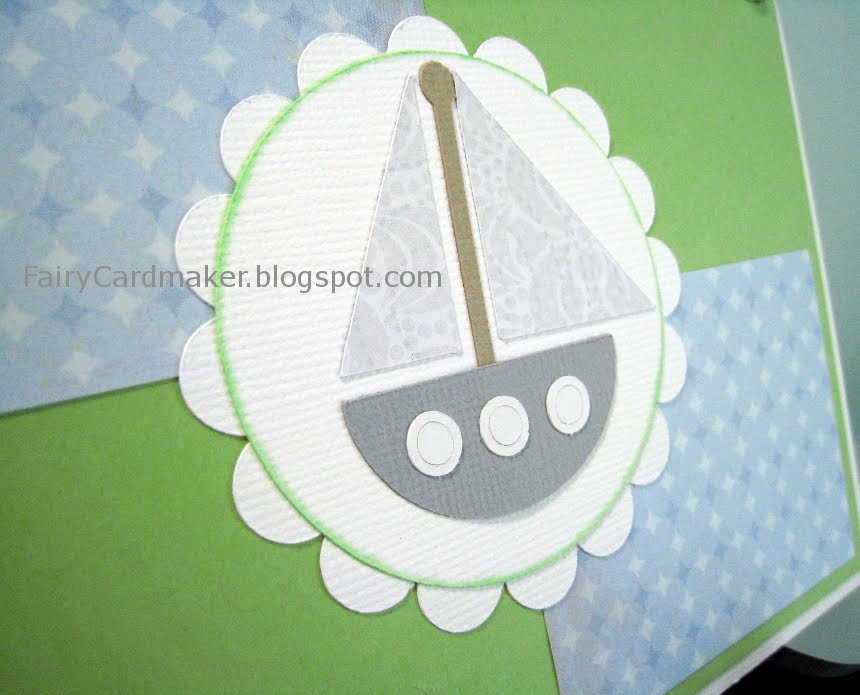
Come Sail Away...


I find that blog challenges are a nifty way get my creative juices flowing.  I had sketched a sailboat die cut about 2 months ago.  Something I saw, that I can't remember now, inspired me to do it.  I finally designed it on the computer a couple of weekends ago but then I didn't know what to do with it after that.  I suppose I could make some vacation "bon voyage" cards, but nothing really grabbed me.  (Actually, I do plan to use it in my scrapbook of my youngest nephew, but I haven't started that project yet!)

Then I saw the Crafty Hos sketch challenge #23!  I thought the centre of this sketch would fit my little boat just swimmingly. Here is the sketch:
I liked the look of square brads like the sketch has.  More straight edges seems more masculine to me.  However, I'm not a big fan of brads, so I had incredible trouble placing them evenly.  Once I was able to wiggle them where I wanted them (which was on my second attempt on the card front), I taped them down well on the back to keep them there!
For some reason, I seem to have a lot of green in my paper stash.  I don't have a whole lot of blue, but lots of green.  I suppose that makes sense - I love blue and I don't really like green.  I was happy to find a use for it!  I coloured around the circle inside the scalloped one with copics.  Copics are indeed a nice marker.  Pricey, but nice.  I have a small collection and I find myself looking for the same few colours that I don't have time and time again.  I will have to write them down next time and then buy them at the store.

My blog has showcased a lot of challenge entries.  I am still very much in the design phase of my shops.  However, I always intended to also cover business topics, like my last post.  I tend to post the challenges though because they have a deadline.  Then I tell myself I'll do the business post "next time".  Redesigning my shops has given me a fresh perspective.  It reminded me why I started selling cards in the first place: to support charity - but on my schedule.  So, get ready for a 2-series post on "The Business of Charity".  Next time.  PROMISE.

Wednesday, June 23, 2010

Business and Social Media


I just read a great article in the June/July 2010 CA Magazine issue.  You can read it too: "Social Equity" by Gilles Lajoie.

The article talks about businesses leveraging off social media to connect with their community and their consumers.  It draws an interesting parallel between how businesses are reacting to social media and how they reacted when Internet-based commerce first started out.  I wanted to share with you a few highlights from it that I found interesting.

My favourite idea in the article is having an "internal" blog amongst your company.  It serves as a team building tool.  It can connect corporate teams in many locations for national and multi-national enterprises.  It refers to an example of how IBM uses social media to allow employees to learn more about the IBM team worldwide.

The article also suggests 10 Commandments of Social Media.  My favourites:
4. Thou shalt say something of substance, and
7. Thou shalt learn to spell
(P.26, CA Magazine, June/July 2010) Read the full article to get the full picture.

In all honesty, I need to work on #1. though: Thou shalt not be a narcissist.  This post is a step in the right direction!

I suggested the idea of a blog to my firm months ago, before Christmas.  However, it is a lot of work to build a professional blog and to constantly publish relevant content.  It would be a time sink for someone, for sure.  Everything has its cost and benefit decisions though.  I hadn't thought of an internal blog.  I think that would be fantastic!  There would be less pressure to produce content and we could make it like an "Ask an Expert" type-thing for internal frequently asked questions.  Those people in the firm who are frequently asked the same thing could just blog about the subject to save them being asked again in the future.  (There are about 4 or 5 of us.)  Blog posts can be edited anytime, so when information changes, the post can be updated.  (Okay, so some of this suggestion is selfish.  I always wanted to be a writer!)

Everywhere I look, I am bombarded with social media invites and promotions.  Of course businesses would want to get in on the picture.  Businesses have to go where the business is!  I guess I never actually clearly thought about it before reading this article though.  It was enlightening to me.  Read it!  What did you think?

SOURCE: http://www.camagazine.com/archives/print-edition/2010/june-july/features/camagazine38246.aspx

ABOUT CA MAGAZINE:
CAmagazine is the leading accounting publication and preferred information source for Canadian chartered accountants and financial executives. It provides a forum for discussion and debate on professional, financial and other business issues. The magazine is published in English and French 10 times a year (with combined issues in January/February and June/July) by the Canadian Institute of Chartered Accountants. Opinions expressed are not necessarily endorsed by the CICA.

CAmagazine.com acts as a complement to the print edition, providing web-only articles and news of interest to CAs, archives, a search function and online classified ads.
SOURCE:  http://www.camagazine.com/about-us/camagazine651.aspx